
MoMA Archives
FRONT END DEVELOPMENT & UI-UX DESIGN | METADATA ANALYSIS & VISUALIZATIONS | CONCEPT TO PROTOTYPE
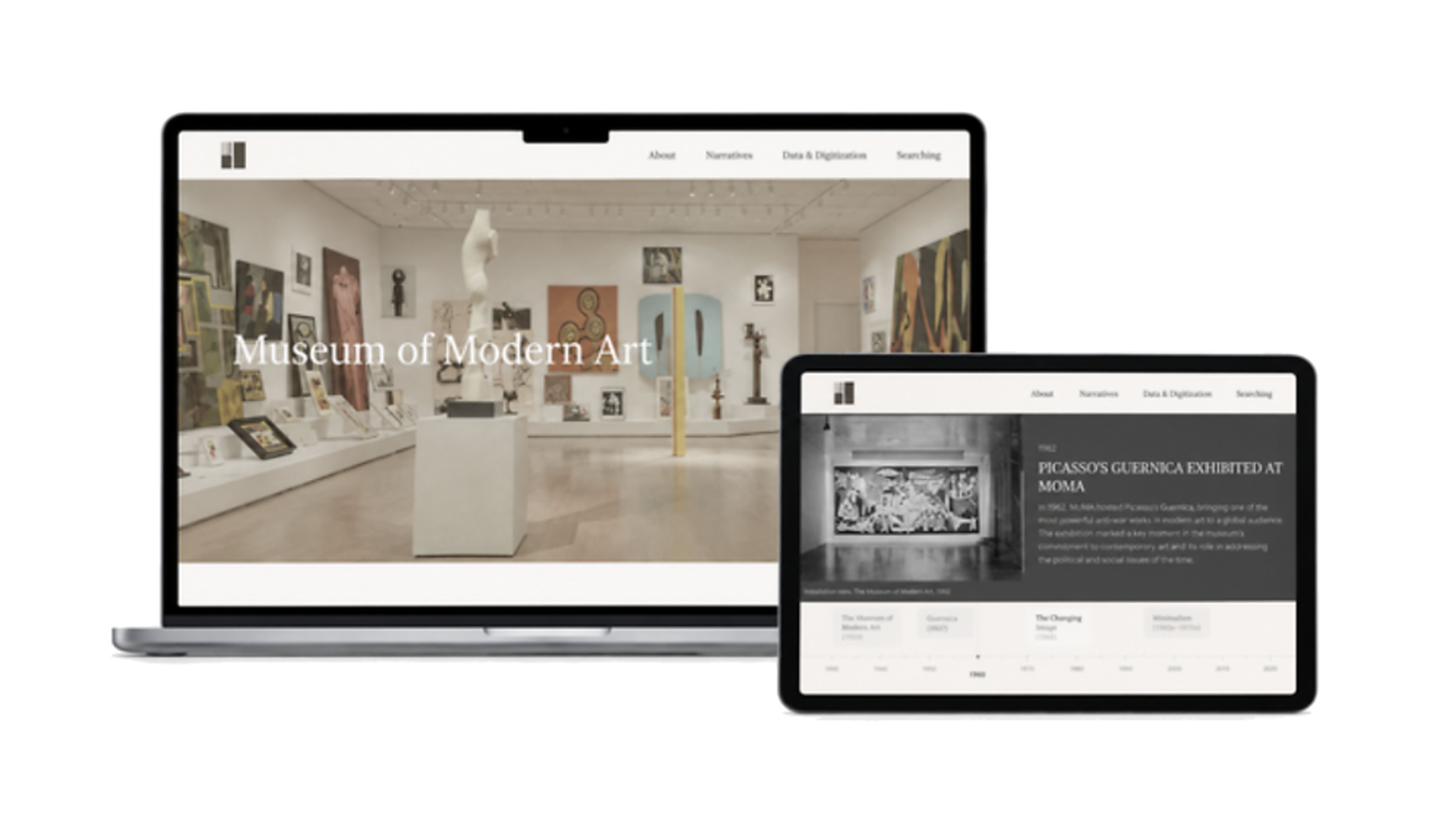
An interactive, museum-inspired website that analyzes MoMA's open collection dataset to surface patterns of representation and absence within the archive.
Role
- UI_UX Designer
- Front End Developer
- Data Analyst & Visualizer
- Content Developer
Timeline
- January – March 2026
- (3 months)
Tools
- Figma
- TimelineJS
- WordPress
- HTML / CSS
- Tableau
- Claude Code
What We Built
An interactive, museum-inspired website that analyzes MoMA's open collection dataset to surface patterns of representation and absence within the archive.
We looked and did a deep dive specifically into artist representation trends, gender distribution, geographic trends, and archival absences.
Team & My Contributions
Visual System
built the Figma component library, typographic scale, and layout templates. Owned all design decisions from lo-fi through final.
Front-End Build
implemented HTML/CSS in WordPress. Embedded data visualizations and TimelineJS as accessible, responsive components.
Data Support
normalized nationality fields, selected which fields to surface and shaped the data-to-story pipeline.
Content Structure
structured interpretive copy so visualizations read as narrative rather than dashboards.
Built with my DH101 classmate group. As the only designer on a 5-person team, I drove every visual decision from the information architecture to the final HTML/CSS build. I also assisted with data cleaning and content structure as the project evolved.
The Problem
MoMA's open dataset contains records for over 130,000 artworks, but in its raw form it's overwhelming, inconsistent, and inaccessible.
Nationality fields had 40+ variations of "American." Gender data was missing or ambiguous. Acquisition dates were sparse. Trends were invisible. Gaps were hidden entirely.
Our Research Questions
Time Lag: How long after an artwork is created does MoMA typically acquire it, and how has this "time lag" changed across different historical periods?
Encoded Power: How does MoMA's artist database encode cultural power through nationality, gender, and metadata completeness, and who is made visible or invisible as a result?
Users
Primary
digital humanities students, art history students, researchers using MoMA's open data
Secondary
designers and artists, and the general public interested in art history or modern art collections
Users vary in data literacy, so the interface prioritizes clarity, clear hierarchy, and interpretation support.
Design Systems
I approached the site as a set of reusable parts rather than one-off pages: a shared typographic scale, a component library in Figma, and consistent interaction patterns for filtering, hovering, and reading a chart. That mattered because the project wasn't static. Fields got added, questions changed, and the data itself was messier than expected. Designing around that uncertainty meant favoring clarity over cleverness, so visitors with very different levels of data literacy could still trust what they were looking at.
Typography
A classic serif carries the headlines and interpretive copy, the same register as a gallery wall label, paired with an italicized subtitle for a quieter, editorial voice. It reads as considered and permanent rather than technical or dashboard-like.
Color Palette
Warm browns paired with white and soft cream, echoing the gallery walls and wood-toned frames of a physical museum. The palette stays simple and restrained on purpose, so visitors focus on the "art," in this case the data and findings themselves, rather than the interface around it.
The Outcomes & Key Findings
87%works made by male artists+
When gender data was cleaned and gaps were flagged, the imbalance became impossible to ignore. Female and non-binary artists represent a fraction of acquisitions, and their metadata is far less complete, compounding their invisibility.
73%works made by American or European artists+
Once nationality variants were standardized, the geographic concentration of the collection became stark. Artists from Africa, Asia, and Latin America account for only a small fraction, and their acquisition dates cluster later, suggesting recency bias.
14 yearsaverage time from creation to acquisition+
The gap between when an artwork was made and when MoMA acquired it has narrowed significantly since the 1980s, suggesting a shift toward contemporary acquisition, but this trend isn’t evenly distributed across artist demographics.